Showing posts with label roman. Show all posts

Friday, 19 May 2017

The Book of Symbol 11...

Olive Tree

Able to root, grow, bear fruit and sustain itself in the dry, rocky soil of the Mediterranean landscape to which it is native, the olive tree evokes the resilience, regeneration and fertility that establish, and succeed, whole civilizations. Van Gogh's painting expresses the spirit of the olive tree, the gnarled trunks that exist for centuries, even a thousand years or more, and their branches that over time are buffered and twisted by the wind until they resemble waves on hillsides above bustling societies and ancient ruins. 

Olive trees perpetually renew themselves from their roots (Psilakis, 209). They resurrect after fire by sprouting new shoots and are able to grow back even if their tops and trunks decay. Cultivated olive strains cannot grow by themselves from seed by must be grafted onto wild olive trees. Saint Paul employed the image in reverse as a metaphor, reminding the Gentile Christians that they were shoots of the wild olive tree, which, contrary to nature, had been grafted on the cultivated olive tree of Jewish Christian believers, whose roots and branches were Israel (Romans 11:13-24). The olive was the Tree of Life for the ancient peoples of Greece and Rome, the Biblical Hebrews and the Muslims. Its fruit, processed with lye or salt, its rich, delectable oil and its wood provided food, light, medicine, fuel and building materials. Evergreen olive branches, their shapely leaves green on one side and silvery gray on the other so that they shimmered in the sun, crowned brides, war heroes and athletic victors who embodied the immortals. Olive oil anointed kings, holy objects for ritual and sacred spaces, and lighted the lamps of home and temple for centuries. Those who approached the Asclepian sanctuary of healing at Epidaurus came "crowned with the wreath of the pure olive," signifying transcendence of destructive forces and rebirth. Before going to Crete to slay the Minotaur, the legendary Theseus dedicated to Apollo an offering with branches form the holy olive tree on the Acropolis (Psilakis, 164ff). Olive garlands and branches were common in the worship of the god Zeus and at the Panathenaea, the games honoring Zeus' daughter Athena, warrior-goddess of the city-state. 
Gnarled, swirling, silvery, Van Gogh's olive trees
seemingly draw together earth and sky in timeless
witness to successions of human endeavor. Landscape
with Olive Trees, oil on canvas, 1889, France.

So essential to the religious, practical and economic life of Greece was the olive that in the sixth century B.C.E., the ruler Solon introduced strict laws for its protection (ibid.)/. Mythically, however, it was Athena who face the olive as a gift to the Greeks, who were cultivating it in Crete as long as 3500 B.C.E. or earlier (Enc.Brit. 8:917). Athena and Poseidon, the divine lord of the seas, held a contest to determine  who would rule Attica. Poseidon struck the rock of the Acropolis with his trident, causing a saltwater spring to burst forth. Athena planted an olive tree beside the rock and her gift was deemed of the greater value; she won Attica and Athens was named in her honor.

Athena's militant aspect primarily served the defense of Athens and its perpetuation as the thriving center of Greek culture. The olive tree's association with life made it the emblem not only of Athena but also of the Roman goddess Pax, or Peace. Messengers seeking truce or asylum would carry an olive branch wrapped in wool (Biedermann, 245). In the biblical story of Genesis, it was an olive branch that the dove brought back to Noah, signifying the recession of the floodwaters and the restoration of harmony between human and divine. That is the olive- symbol of the quintessence that survives the dissolution of the old forms and renews itself from the roots up. 

Biedermann, Hans. Dictionary of Symbolism.
NY, 1994.
Psilakis, Nikos. The Olive Wreath: The Wreaths 
of the Olympic Winners, Symbolic and Moral Background.
 Heraklion [Crete], 2003.

~Bella

Friday, 27 May 2016

Le petite bretonne aux Etat-Unis....

Brittany or commonly known as Bretagne in France is a region full of history.
I'm a fanatic of history, learning about it all! I think I take this trait from my grandfather, thank you :)


Let's start off with a little bit of a history lesson.

I'm far from being the greatest teacher but I'll try my best to keep you entertained!


First, Brittany is the north-west coast of France, it's considered one of the regions where it rains all the time. That is not entirely true so stop believing it and just go it's a beautiful region that has plenty charm.
The history is quite entertaining and there's always something new to learn about this region like the Celtic side of it. You may think of Ireland when you hear Celtic and it does have similar aspects like the stones... The enchanting tales...  To be honest, there's a plenty of legends like Lancelot or Merlin, druids. There's even a forest called Broceliande based on all these tales. It's a must go visit the place.
Besides, the Celtic side, there's a Roman side with Ceasar wanted to conquer the Gaul (France at the time), and you can still see the Roman remains in some cities like Dinan. The conquest that Ceasar tried to gain for his empire was an inspiration for the legendary Asterix and the magic potion that would be used to fight off the Romans. Sadly, it wasn't at all true, no one had potions, no one was invincible, history was a little different.
After the Roman fall, Irish people immigrated (it's what it's written in history, there might have been others before), the British/ Anglo-Saxon came to the land. They had a strong impact, building the first cathedrals. In many little Breton churches, you can see the tales of fighters, and Saints that came in the region.
To summarize a little the history of Brittany, after the Romans, Anglo-Saxon came and till this day, we can recognize that there's a lot more traces of Celts around the whole region. It's a little Britain but in France.

Brittany has traditions, it's own language that you may learn at school, grand-grandparents would still speak Breton which is similar to Welsh and Cornish. Castles are still standing looking more magnificent and full of mysteries. The rural part of the region still holds lots of the origins, and the rural part still manage to have a strong character, nothing like Los Angeles. It's a must-see region!
Part of traditions, there's festivals where people can dress up as their elders, the costumes they would wear in a daily life.
I love symbols and know a lot about them. They have quite a lot, but here's a few:
- The Gwenn ha du (black and white in Breton) is referring to the stripy Breton flag. It's everywhere!
- Towering lighthouses are everywhere as well. Brittany holds a lot more than any other regions. If you visit, you cannot leave the place without a postcard represent a lighthouse!
- Coiffes, or lace bonnets... Worn by women in France in the past, but in the southwest Brittany, the tradition of wearing them grew to exceptional proportions and sadly died after generations of wearing them. From experience, it hurts, you will get headaches after you take the coiffe down! You will see them during festivals, the most common one is in Quimper. Beautiful city and beautiful festivals!
- B is butter... The salted butter, Santa Cleopatra, it's the best in the world! But B can also be for Bécassine... She is a fictional character from books that I used to read when I was younger. It's a reflection of the peasant that lived in Brittany.                                      
- Hortensia or commonly known as Hydrangea,  you will find them everywhere!
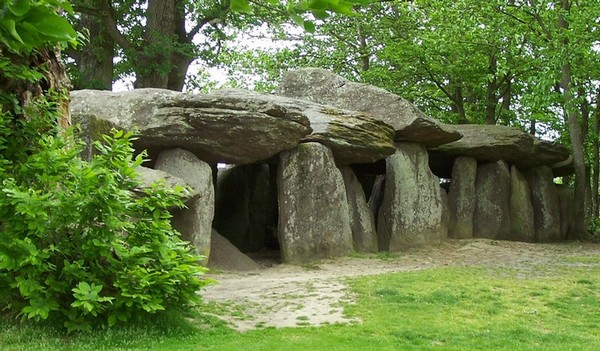
- Megaliths, those stones like in Ireland, we have a few of them in circles...
- The Triskel! Very Celtic symbol that is beyond what you may imagine. People get them tattooed on them, especially on the ankle. It represents three major Celtic Gods (Lugh, Dagda, and Ogma), the three elements (Fire, Earth and Water), time (Past, Present and Future) and the three worlds (World of the Living, World of the Dead and the world of the Spirits).  It has been the emblem of the Breton National Party since 1940!


Since I was talking about tradition and symbols, I believe that I can also talk about the food!
Being close to the ocean, you cannot deny that obviously means seafood! I cannot begin to describe the food, it would take an entire post to detail you everything... So until next time... But... I can talk about crêpes (sweet featherlight) and galettes( savoury buckwheat) ! You call them pancakes, honestly, I don't see much resemblance! Crêpes are the sweet ones, the one you spread Nutella on, or jam, sugar, butter, lemon, fruits... I always tend to turn for the Nutella one, not surprising! :)
Then you have the more complex one where you may put cheese, eggs, and ham, it's called
 "La Complète". You may have anything you want in them from spinach to seafood. The choice is endless!

Many of you may have never tried any galettes nor crêpes, but let me tell you, it's the best dish ever! It may look different from what you may be used to see and eat, but honestly, you can't just not try them at least once. I have heard that the galette is the one that most people have a hard time eating, don't get me wrong, it's a very different taste, not in a bad way, on the contrary! You won't and can't not love it. I'm a huge fan! You'll definitely have to have it before you die!

Just a little note, I'm half Bretonne (Breton), so the Celtic and Roman side of me are present! I'm proud of whoI amm and being Bretonne. People say that we are cold people, but we ar the ones that once friends we are there for you through tough times. We are big travelers (that doesn't stop me from being sea sick), and we love our festivals and dances! Our drinks like Cider (no, not the sparkling apple cider, the real one with the alcohol in)! I have indeed learned the language at school, still sing happy birthday in the language, it's actually hilarious to hear, it sounds very Welsh. We are proud of our origins and our crêpes... Oh and we have our own Coca-Cola!


" A l'Aise Breizh..."


~Bella